

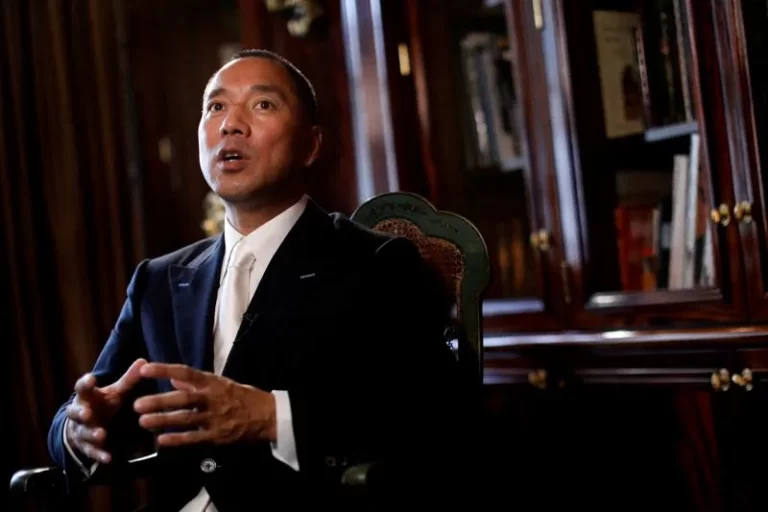
Exiled Chinese businessman Miles Guo is accused of swindling his followers out of more than $1 billion, according to a federal prosecutor who laid out the charges as Guo’s high-stakes fraud trial opened in New York on Friday.
In opening arguments, Assistant U.S. Attorney Micah Fergenson told the jury that Guo, who built his fortune in real estate back in China, relocated to New York and gained a massive following by publicly denouncing the Chinese Communist Party through a stream of online videos.
But after authorities in China and Hong Kong seized his properties, prosecutors claim Guo began pitching bogus investment opportunities to his supporters, allegedly using the money to bankroll an ultra-luxurious lifestyle.
READ MORE: From Credit Card Chaos to Financial Freedom How I Paid Off £5,000 Spent on Fashion and Holidays
According to Fergenson, the case is centered around what he described as a “simple but staggering” fraud scheme.
He alleged that Guo siphoned off funds from thousands of loyal followers, using their money to maintain the trappings of extreme wealth while posing as a dissident fighting the Chinese regime.
“He lived like a billionaire,” Fergenson told the jury, “because he tricked his followers into making him one.”
The 12-member Manhattan jury is now tasked with weighing charges that the exiled mogul used his widespread online influence to lure supporters into pumping money into various ventures, only to reroute those funds for personal indulgence.
Guo, who also goes by several aliases including Guo Wengui, Miles Kwok, and Ho Wan Kwok, has been held in custody in Brooklyn since his arrest in March 2023. He has denied all wrongdoing.
Representing Guo in court, defense attorney Sabrina Shroff painted a very different picture of her client. She argued that Guo’s business dealings were legitimate and driven by a desire to create a global movement opposed to the Chinese Communist Party.
“It wasn’t a con, it wasn’t a hustle, and it certainly wasn’t illegal,” she told jurors.
Shroff emphasized that Guo had every reason to take extra precautions – including the use of multiple phones and bank accounts due to what she described as ongoing attempts by the Chinese government to undermine him.
She also cautioned jurors not to make assumptions based on how Guo chose to spend his money, which she said was the result of wealth he earned through legitimate real estate ventures.
Federal prosecutors, however, say the fraudulent behavior began as early as 2018, when Guo began promoting a series of Mandarin-language online videos offering lucrative financial opportunities.
These included investments in a media company he founded, a supposed cryptocurrency project, a farming loan program, and an elite membership club that promised concierge-style perks.
Authorities allege the funds collected from these ventures were instead funneled into personal extravagances. Among the lavish purchases attributed to Guo: a sprawling New Jersey estate, a luxury yacht, high-end vehicles, and even a pair of $36,000 mattresses.
Guo now faces a total of 12 charges, including conspiracy, wire fraud, money laundering, and racketeering. The trial, overseen by U.S. District Judge Analisa Torres, is expected to last through the summer and may continue into July.
A prominent and vocal critic of the Chinese government, Guo has long claimed that the charges leveled against him – both in China and now in the United States – are politically motivated.
He previously fled China in 2014 amid President Xi Jinping’s sweeping anti-corruption campaign. Chinese authorities have accused him of crimes ranging from bribery to money laundering, which he has firmly denied.
After arriving in the U.S., Guo purchased a luxury apartment in the Sherry-Netherland Hotel on Fifth Avenue and began growing a digital presence through his outspoken opposition to Beijing.
In April 2017, China requested Interpol issue a red notice for Guo’s arrest, shortly after he gave an interview to Voice of America, a U.S. government-funded outlet.
On Friday, Shroff argued that the red notice was a retaliatory move by the Chinese government meant to silence Guo for speaking out. The defense maintains that Guo is not a fraudster, but rather a political target – a man who amassed wealth legally and used it to fund a cause he believed in.
Guo has also been publicly linked to Steve Bannon, the former Trump advisor, who was famously arrested in 2020 aboard Guo’s $37 million yacht, the Lady May, as part of a separate fraud investigation.
Bannon was later pardoned by Donald Trump in the final hours of his presidency. Guo, however, remains on trial, now facing the possibility of years behind bars if convicted.
READ MORE: I Earn £50,000 a Year Working Only 6 Hours a Week – All Without a University Degree